
Office relocation is the coordinated move of a company’s people, furniture, IT, and operations from one workspace to another. The goal is to reduce downtime, protect assets, and maintain business continuity. In Ras Al Khor, Service Zone UAE handles planning, packing, transport, and setup so teams get back to work fast.
By Mohammed Ali, Service Zone UAE — Owner, Real estate Specialist
Last updated: 2026-05-10
Above-Fold Overview: Hook, Summary, and TOC
Plan office relocation like a project: define scope, assign owners, map a week-by-week timeline, and coordinate IT cutover. Use professional movers for packing, transport, and reinstatement. A clear runbook, labeled crates, and a rehearsed move-day plan prevent delays and get teams productive on Day 1.
Moving offices doesn’t have to stall your business. With a tight checklist and a partner who manages logistics end to end, you can relocate with minimal disruption and zero guesswork. This guide explains how we execute smooth, on-time moves for Dubai companies.
- What office relocation means for operations, IT, and people
- Why timing, sequencing, and labeling reduce downtime
- How a week-by-week plan eliminates surprises
- Approaches for phased, overnight, and weekend moves
- Best practices for IT cutover, packing, and reinstatement
- Tools, templates, and checklists you can use today
- Mini case studies from Dubai moves we’ve delivered
Table of contents
- What is office relocation?
- Why office relocation matters
- How office relocation works (step-by-step)
- Types and approaches
- Best practices
- Tools and resources
- Case studies
- FAQ
- Conclusion and next steps
What Is Office Relocation?
Office relocation is a structured transition of a company’s workspace, technology, and furniture to a new location with minimal interruption. It spans planning, packing, transportation, reinstatement, and IT cutover. Success is measured by uptime, safety, and how quickly staff can resume normal operations in the new office.
In practice, office relocation combines project management, facilities coordination, and specialized moving. It touches every function: leadership, HR, IT, finance, and operations. The essential outcomes are clear: protect assets, meet building rules, and have workstations live on Day 1.
- Scope: furniture, files, IT hardware, signage, and occasionally fit-out touch-ups.
- Stakeholders: move lead, department coordinators, IT lead, facilities, security.
- Milestones: sign lease, inventory assets, pre-move labeling, move-day execution, post-move fixes.
- Dependencies: elevator access, permits, loading bays, and network activation windows.
At Service Zone UAE, our team in Ras Al Khor runs this as a formal project: a dated schedule, named owners, and documented handoffs. That keeps decisions fast and accountability clear.
Why Office Relocation Matters
A well-planned office relocation protects revenue, morale, and client commitments. The right sequencing lowers downtime, prevents IT outages, and avoids damage. When teams sit down on Day 1 with working internet and labeled workstations, change feels like progress—not disruption.
Moves ripple across people and systems. Without a plan, helpdesk tickets spike, orders slip, and managers scramble. With a plan, moves unlock upgrades: better layout density, improved AC airflow, cleaner cable management, and safer electrical distribution. Those gains pay back through productivity.
- Business continuity: time your cutover to occur off-hours and test before staff arrival.
- Employee experience: reduce uncertainty with maps, labeling, and welcome instructions.
- Asset protection: use anti-static wraps, foam, and heavy-duty crates for IT and monitors.
- Facility health: pair the move with AC checks, electrical tests, and minor painting touch-ups.
From our experience across Dubai, the best indicator of success is the first hour on Day 1: if users log in, print, and join calls without delays, your plan worked.
How Office Relocation Works (Step-by-Step)
Run your office relocation as a dated project plan: discovery, inventory, labeling, packing, transport, IT cutover, reinstatement, and post-move fixes. Assign owners, set freeze windows, and rehearse load-in/load-out. A dry run for the IT stack prevents Day 1 surprises.
Below is a pragmatic sequence we use for Dubai companies. It’s flexible for phased or overnight moves and scales for 10 to 300+ seats.
Phased timeline (suggested)
| Phase | Timing | What happens | Key deliverables |
|---|---|---|---|
| Discovery | Week -6 | Confirm scope, constraints, building rules, elevator bookings, loading bays. | Project brief, stakeholder map |
| Inventory | Week -5 | Audit furniture, PCs, servers, peripherals; tag items by team/workstation. | Asset register, labeling scheme |
| Preparation | Week -4 to -3 | Distribute crates, issue packing rules, schedule AC/electrical checks. | Packing SOP, permits booked |
| Pre-pack | Week -2 | Non-essentials boxed first; IT builds new site network and tests ports. | Labelled crates, network smoke test |
| Freeze | Week -1 | Change freeze; final packing; print seating plans; confirm security and access. | Go/no-go checklist |
| Move Day | Weekend/overnight | Load-out, transport, load-in; desk assembly; cable management; IT cutover. | Signed move log, cutover record |
| Stabilize | Day 1–3 | Floor-walk support, fix tickets, alignment checks, AC balancing. | Punch list closed |
Packing and protection standards
- IT first-class handling: anti-static bubble wrap, foam inserts, and dedicated crates.
- Monitor safety: screen protectors and upright transport; never stack bare screens.
- Labeling: every crate shows team, new zone, and seat code (three data points minimum).
- Cable management: coil and zip-tie; bag per-desk cables to avoid crossovers.
We embed quality checks into each stage and keep a shared move log. That live log captures truck departures, arrivals, floor handovers, and sign-offs per zone.
Types/Methods/Approaches
Choose a move approach that matches your risk and schedule: phased moves minimize risk, overnight moves compress downtime, and weekend moves align with staff availability. For hybrid teams, consider a rolling-churn plan that migrates zones as people rotate on-site.
Common approaches
- Phased move: relocate 20–30% of seats per wave. Benefits: lower risk, easy troubleshooting. Trade-off: longer timeline.
- Overnight move: full cutover after hours. Benefits: fast Day 1 readiness. Trade-off: requires meticulous prep and a rehearsed crew.
- Weekend move: similar to overnight with more buffer for fixes; good for customer support teams.
- Hybrid roll: move zones to match in-office schedules; ideal when attendance is staggered across the week.
- Internal churn: re-stack within the same building; still treat as a project with labeling and permits.
When to use storage
- Staggered fit-out: store surplus furniture until final layout is complete.
- Asset rotation: archive files or seasonally used gear in secure storage to free floor space.
- Space testing: trial a hot-desk layout before committing to full seating density.
If you anticipate layout iterations, pairing your move with short-term storage prevents clutter and keeps aisles clear for safety inspections.
Best Practices for an Efficient Move
Document everything: a dated timeline, ownership by task, crate counts per team, and access windows per building. Label thoroughly, pre-test the new network, and freeze nonessential changes a week before cutover. On move day, track every truck, zone, and handover in a live log.
Execution habits that cut downtime
- One plan, one owner: assign a single move lead; publish a contact tree for escalations.
- Visual seating plans: post maps at entries and print seat labels for quick wayfinding.
- IT dry run: validate VLANs, DHCP, and printing at the new site before move day.
- Permit calendar: confirm elevator, dock, and security access times in writing.
- Safety walkthrough: clear egress paths; protect floors; stage dollies and ramps per zone.
- Readiness gates: don’t release a zone until desks, power, data, and signage are confirmed.
Facilities tune-ups we often bundle
- AC services: filter changes and airflow balancing reduce hot spots after re-stack.
- Electrical checks: test outlets, RCDs, and load distribution to avoid nuisance trips.
- Painting touch-ups: repair scuffs and patch anchor holes for a clean brand look.
- Carpentry fixes: adjust doors, mount screens, and secure privacy panels.
Local considerations for Ras Al Khor
- Schedule dock and elevator access early; Ras Al Khor buildings can have busy loading windows during peak business hours.
- Plan IT cutover for cooler evening hours; equipment staging runs smoother when temperatures are lower.
- Coordinate parking and wayfinding for crews; clear signage reduces dwell time during load-in/out.
We also recommend a short floor-walk on Day 1 to close punch-list items fast—users feel supported, and minor issues don’t snowball.
Tools and Resources (Templates You Can Use)
Standardize your move with simple, reusable tools: an inventory sheet, labeling schema, crate calculator, week-by-week timeline, and an IT cutover checklist. Centralize files in one shared drive so every stakeholder works from the same playbook.
Planning and control
- Asset inventory sheet: list workstations, monitors, peripherals, and special assets (e.g., lab gear).
- Crate calculator: estimate crates per team based on seat count and file volume.
- Timeline template: map phases by week with owners and dependencies.
- Risk register: log constraints like elevator windows and network activation dates.
IT cutover pack
- Port test sheet: record pass/fail for data points at each desk and meeting room.
- Printer validation list: confirm drivers and test prints from sample machines.
- Change freeze notice: pause noncritical changes seven days pre-cutover.
Staff communication
- Seat assignment map: publish PDFs with color-coded zones.
- Welcome instructions: day-one login, printing, and helpdesk QR for quick support.
- Labeling guide: three-field label: team, zone, seat—consistent across all crates.
For a service-led approach, see our office moving page for scope details and coordination examples, and explore our moving services to align storage and transport with your timeline.

Case Studies and Real-World Examples
Real moves show what works: phased schedules for complex IT, overnight cutovers for call centers, and bundled maintenance to stabilize fast. The common thread is disciplined labeling, rehearsed logistics, and on-site support during the first 72 hours.
Case 1: 80-seat phased move (Dubai)
- Challenge: finance and sales teams needed zero data loss and live printing on Day 1.
- Approach: three waves over two weekends; IT patched and tested each zone before staff arrival.
- Services used: Office Moving, Storage Service, AC Services for airflow balancing.
- Outcome: staff logged in within minutes; punch list closed in 48 hours.
Case 2: Overnight call center cutover
- Challenge: support lines had to be live by 8 a.m. without dropped tickets.
- Approach: overnight full move; pre-labeled headsets and per-desk cable kits.
- Services used: Office Moving, Electrical Work (load checks), Carpentry (monitor arms).
- Outcome: zero missed service windows; quality checks completed before shift start.
Case 3: Executive floor refresh with storage
- Challenge: modernize layout while safeguarding premium furniture.
- Approach: stored legacy pieces, painted accent walls, and reinstalled SPC flooring sections.
- Services used: Storage Service, Painting, SPC Floor, Carpentry.
- Outcome: brand-consistent finish and improved lighting reflections for video calls.
These patterns repeat: disciplined prep reduces risk, while on-site floor-walks resolve snag lists quickly. Our Ras Al Khor crew coordinates with building management so dock times, elevators, and access cards are ready when we arrive.
Need a relocation runbook? We’ll map your timeline, label schema, and IT cutover plan in a single workshop. Start with our office moving services guide and book a consultation.
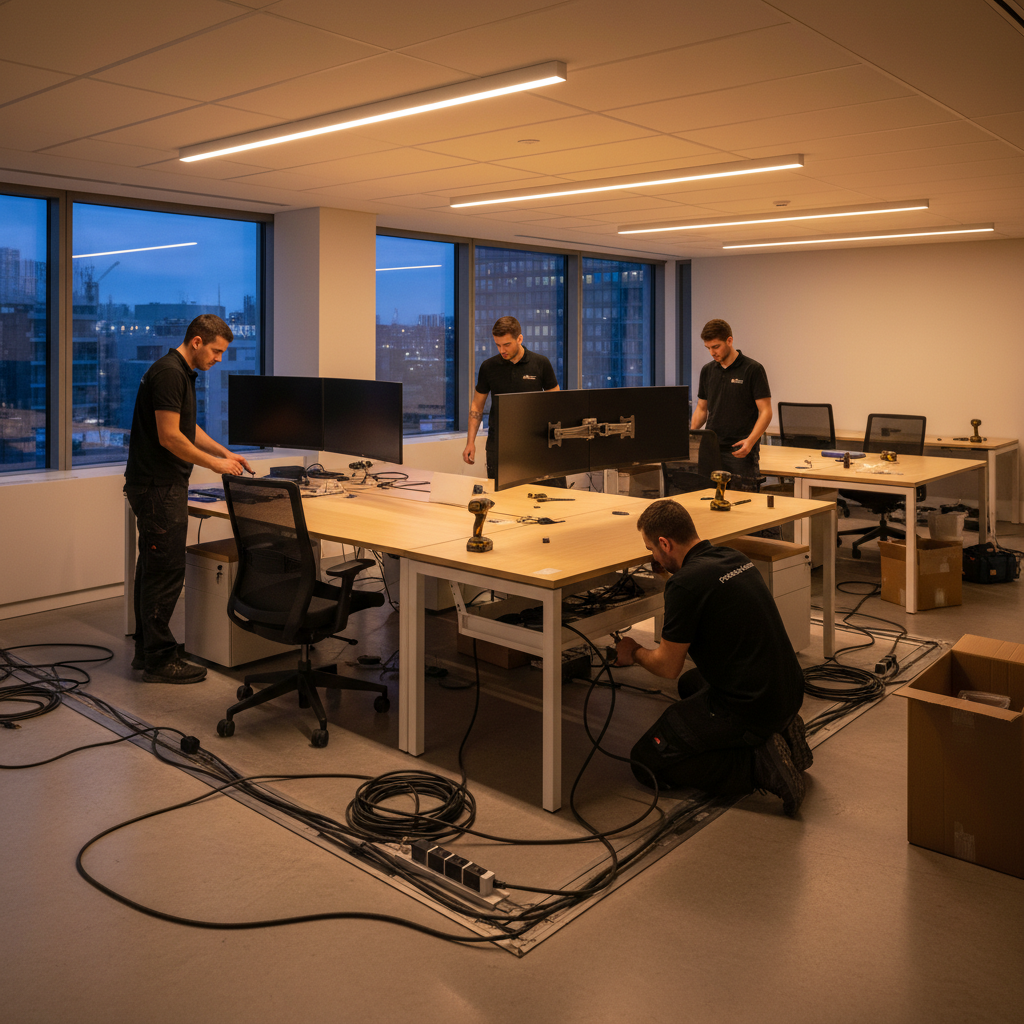
Frequently Asked Questions
Most office relocation questions focus on timing, responsibilities, and IT continuity. The best answer is a dated plan with named owners, a labeling standard, and a confirmed cutover window. Clear communication keeps staff calm and productive during change.
How far in advance should we start planning an office relocation?
Start six to eight weeks ahead for most small to mid-sized offices. That window covers asset inventory, labeling, building permits, and IT pre-testing. Larger, regulated, or specialized environments may need more time, especially if you’re staging storage or fit-out updates.
What should our staff pack versus the movers?
Have staff pack personal items and desk contents into labeled crates using the three-field standard (team, zone, seat). Professional movers handle monitors, CPUs, peripherals, and furniture with protective materials. This split keeps users safe and protects sensitive equipment.
How do we ensure IT works on Day 1 after the move?
Perform a pre-move IT dry run at the new site: validate ports, VLANs, DHCP, Wi‑Fi, printing, and conference room gear. Freeze nonessential changes a week before cutover and schedule a floor-walk support desk for the first two days to resolve any issues fast.
Do we need storage during an office relocation?
Short-term storage helps when fit-out dates slip, when you’re testing new layouts, or when archiving seasonal equipment. Secure storage keeps aisles clear and protects assets while you sequence the final office design.
Conclusion and Next Steps
Treat office relocation as an operations project with a clear owner, dated milestones, and a rehearsed cutover. Label thoroughly, protect IT, and stabilize with on-site support. With disciplined planning, your team returns to full productivity on Day 1.
Key takeaways
- Plan six to eight weeks ahead with a dated timeline and owners.
- Use a three-field labeling standard on every crate and device.
- Pre-test networks, printing, and meeting rooms before cutover.
- Bundle AC, electrical, painting, and carpentry tune-ups for Day 1 polish.
- Stage storage to avoid clutter and keep egress paths clear.
Action steps
- Download or create an inventory sheet and labeling guide.
- Book elevator and dock windows with both buildings.
- Schedule an IT dry run and confirm the change freeze date.
- Assign a move lead and publish a contact tree for escalations.
- Ask our Ras Al Khor team to review your plan and close gaps early.
Ready to move with less downtime? Explore our packing and moving guide, review our Dubai relocation overview, and see how we plan storage timelines. Book a discovery session in Ras Al Khor and let’s build your runbook.